In modern sheet metal manufacturing, cutting and forming are only part of the process. The flatness and stability of the sheet itself can have a significant impact on the quality of the final component.
This is where precision leveling plays an important role.
During processes such as laser cutting, punching and forming, sheet metal can develop internal stresses and distortions. Even when the cutting dimensions are accurate, a sheet that is not sufficiently flat can create problems during bending, welding and assembly.
At Shree Varda, precision leveling is an integral part of our sheet metal manufacturing process, helping us achieve consistent flatness and improve the overall quality of fabricated components.
What Is Precision Leveling?
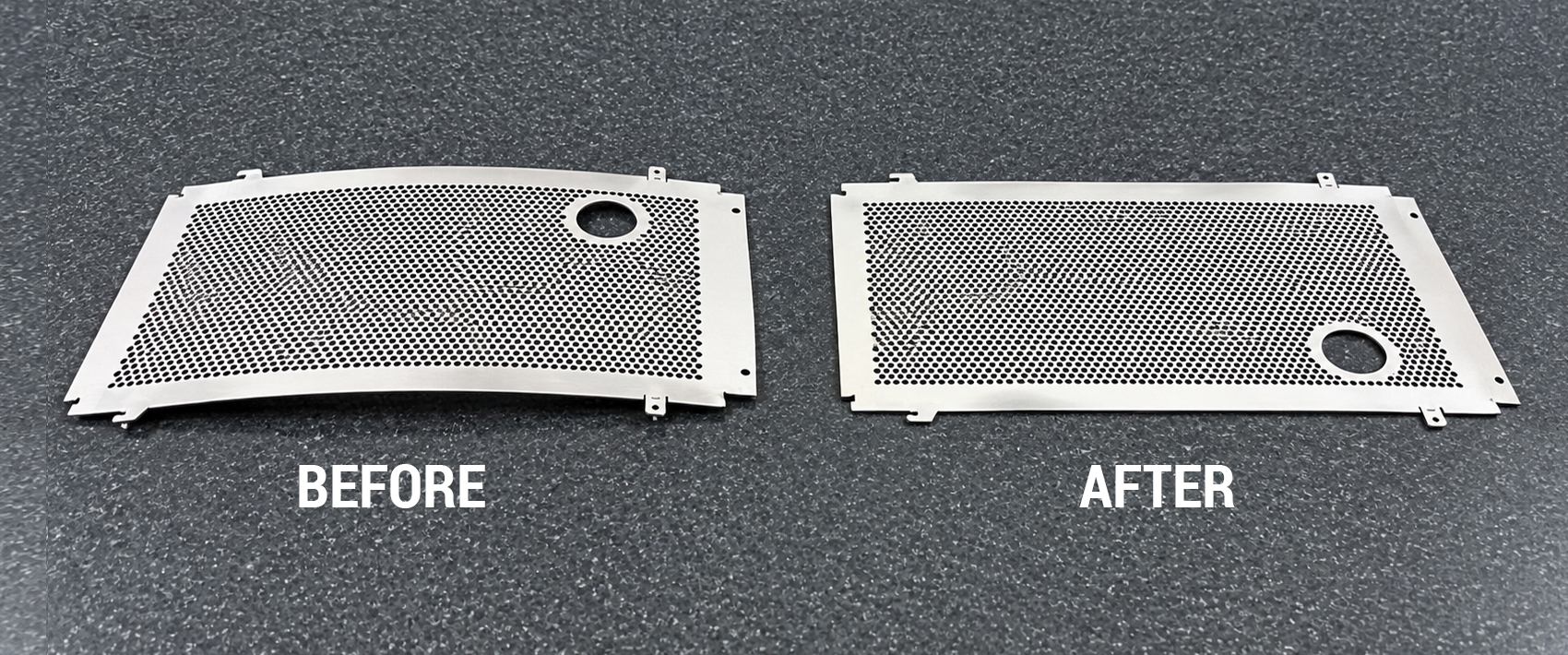
Precision leveling is a controlled process used to improve the flatness of sheet metal components by reducing unwanted stresses and shape deviations in the material.
The component passes through a series of leveling rolls that apply controlled bending to different areas of the material. This progressively reduces uneven stresses and produces a flatter, more stable sheet metal part.
Unlike simply pressing a sheet flat, precision leveling focuses on improving the material’s overall flatness and stability.
Why Does Sheet Metal Become Distorted?
Sheet metal components can experience deformation or residual stress at different stages of manufacturing.
Some common causes include:
- Laser cutting and thermal input
- CNC punching
- Slitting and shearing
- Material handling
- Forming operations
- Uneven internal stresses within the sheet
- Changes in material thickness and properties
For example, when a large number of components are cut from a sheet using a laser, localized heat can cause stresses within the material. After cutting, the remaining sheet or individual components may no longer remain perfectly flat.
This can become particularly important when the component requires accurate bending or assembly.
How Precision Leveling Improves Manufacturing
1. Better Flatness
The primary objective of precision leveling is to improve the flatness of the sheet or component.
Better flatness provides a more stable starting point for subsequent manufacturing operations.
The primary objective of precision leveling is to improve the flatness of the sheet or component.
Better flatness provides a more stable starting point for subsequent manufacturing operations.
2. Improved Bending Accuracy
A flat and stable component is easier to position accurately during CNC bending.
When the material has unwanted distortion, it can affect how the component sits against the tooling and may contribute to variations in the final bend.
Precision leveling helps create a more consistent base condition before bending.
A flat and stable component is easier to position accurately during CNC bending.
When the material has unwanted distortion, it can affect how the component sits against the tooling and may contribute to variations in the final bend.
Precision leveling helps create a more consistent base condition before bending.
3. Better Welding and Fabrication
Distorted components can create gaps or alignment problems during welding and fabrication.
Distorted components can create gaps or alignment problems during welding and fabrication.
A flatter component can improve:
- Part-to-part fit-up
- Joint alignment
- Welding consistency
- Assembly accuracy
This becomes particularly important for larger fabricated structures and precision assemblies.
4. Improved Assembly
In many industrial products, several sheet metal components need to come together accurately.
Even a relatively small amount of distortion can create problems when multiple parts are assembled together.
Precision leveling helps provide more dimensionally stable components, making downstream assembly easier and more consistent.
In many industrial products, several sheet metal components need to come together accurately.
Even a relatively small amount of distortion can create problems when multiple parts are assembled together.
Precision leveling helps provide more dimensionally stable components, making downstream assembly easier and more consistent.
5. Reduced Rework
Manufacturing problems discovered at the bending, welding or assembly stage can result in additional handling, adjustment and rework.
Correcting flatness earlier in the manufacturing process can help reduce these problems and improve overall production efficiency.
Manufacturing problems discovered at the bending, welding or assembly stage can result in additional handling, adjustment and rework.
Correcting flatness earlier in the manufacturing process can help reduce these problems and improve overall production efficiency.
Precision Leveling vs. Conventional Straightening
It is important to distinguish precision leveling from conventional straightening.
Traditional straightening often focuses on correcting visible deformation at specific locations.
Precision leveling takes a more controlled approach by progressively working the material across its width and length to reduce internal stresses and improve overall flatness.
The objective is not simply to make a visibly distorted sheet look flat, but to create a more stable material condition for the next manufacturing operation.
It is important to distinguish precision leveling from conventional straightening.
Traditional straightening often focuses on correcting visible deformation at specific locations.
Precision leveling takes a more controlled approach by progressively working the material across its width and length to reduce internal stresses and improve overall flatness.
The objective is not simply to make a visibly distorted sheet look flat, but to create a more stable material condition for the next manufacturing operation.
Where Is Precision Leveling Particularly Useful?
Precision leveling can be valuable for components where flatness and dimensional stability are important.
Precision leveling can be valuable for components where flatness and dimensional stability are important.
Typical applications include:
- Electrical enclosures
- EV charging equipment
- Solar equipment
- Industrial cabinets
- Machine enclosures
- Automotive components
- Precision fabricated assemblies
- Energy equipment
- Industrial equipment and structures
The importance of leveling increases when components have tight dimensional requirements or need to undergo multiple downstream processes.
The Role of Leveling in a Complete Manufacturing Process
Precision leveling should not be viewed as an isolated operation.
Precision leveling should not be viewed as an isolated operation.
A typical sheet metal manufacturing process can involve:
Raw Material → CNC Laser Cutting / Punching → Precision Leveling → CNC Bending → Fabrication → Surface Treatment → Assembly → Quality Inspection
Controlling the material condition at an early stage can help improve consistency throughout the manufacturing process.
Precision Leveling at Shree Varda
At Shree Varda, we combine advanced CNC sheet metal processing with precision leveling to provide a complete manufacturing solution for industrial components.
Our manufacturing capabilities include:
- CNC Laser Cutting
- CNC Punching
- CNC Bending
- Precision Leveling
- Sheet Metal Fabrication
- Welding
- Powder Coating and Surface Treatment
- Assembly
Our precision leveling capability is powered by German ARKU technology, allowing us to focus on material flatness and stability before subsequent manufacturing operations.
Combined with our TRUMPF CNC technology, this enables us to maintain a controlled and integrated manufacturing process from sheet processing through fabrication.
Conclusion
Precision leveling may be a less visible step in sheet metal manufacturing, but it can have a significant effect on the quality of the final component.
Better flatness can contribute to improved bending, welding, assembly and dimensional consistency while helping reduce manufacturing issues and rework.
For applications where flatness, accuracy and repeatability matter, precision leveling can be an important part of a modern sheet metal manufacturing process.